The Theban alphabet
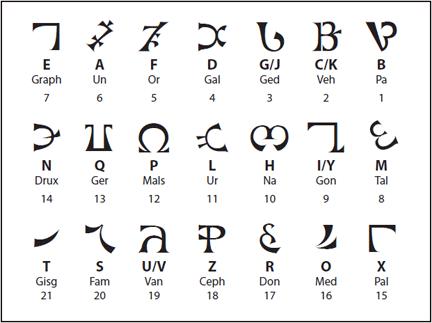
Notable Features
- Written from left to right in horizontal lines
- Corresponds to the Latin alphabet
- The letters ‘J’ and ‘U’ are represented by the letters for ‘I’ and ‘V’
- It can be used to write spells and inscriptions
- It is used to disguise the meaning of a text
- Before the 20th century they were largely called ‘Theban letters’ or ‘Theban alphabet’
- The letter-forms are more suited to scripture as they are cursive
Purpose and Usage
- Lends an air of mystery
- Inscription on items for reasons such as protection
- Enables Witches to communicate among themselves
- Retains the secrecy of Witches and spells
- Inscription on candles and stones
- Used like the Christian crucifix or the Pagan Thor’s hammer
History
Emerging during the medieval period when Cabbalistic studies in the practices of European magicians, usually referred to as ‘Witch writing’, ‘Witches runes’ or the ‘Witches alphabet’. It was apparently first published in the Polygraphia by Johannes Trithemius in 1518, although it is more reputably sourced from Agrippa, it is said that Agrippa was Trithemius’ student. The Theban alphabet is in the Three Books of Occult Philosophy by Cornelius Agrippa and was published in 1531 on chapter 29 of book 3. Agrippa writes “Of this kind of character therefore are those which Peter Apponus notes, as delivered by Honorius of Thebes”. Referring to the early 14th century Liber Juratus Honorii although the Theban characters do not appear in any manuscript. He states that a 13th century Italian magician attributes the alphabet to Honorius although Honorius was a Mogus not a Witch.
It is also said to be originated as a Latin cipher before the 11th century, the evidence is consistent as an early alchemical cipher alphabet influenced by Avestan. Or it could be from The Magus by Honorius II in the early 1200’s. This often uses a stylized character at the end of writing, its translated as the Greek Alpha and Omega.
The Hermetic order of the Golden Dawn and successors such as the Ordo Templi Orientalis adopted the Theban alphabet from Agrippa by the end of the 1800’s. There are some plagiarisation’s of Agrippa including The Magus by Francis Barret in 1801. It seems the Theban alphabet has been passed on to Wiccan’s from the Golden Dawn’s successors as part of the Gardenerian reinvention of Wicca in the 1930’s. To this day they are commonly used by Wiccan’s and is associated as the ‘Wiccan alphabet’.


Biblography
REFERENCE: Proposal to add the Theban Alphabet to ISO/IEC 10646 by Eric S. Raymond
REFERENCE: The Witches Alphabet on Witchesofthecraft.com
FURTHER READING: The Witches Alphabet: How to Write Theban for Beginner’s by Zackary Davis
RESOURCE: Theban TrueType Font on Fontpalace.com
REFERENCE: Theban Script on Coven-of-cythrawl.com
REFERENCE: Theban Alphabet on Omniglot.com
RESOURCE: The Witches Alphabet Theban Script on Afrimage.org (more images for Theban)


 Witchpost